Why Your Bathroom Deserves a Better Solution Than Chemical Sprays

Natural bathroom odor remover options are more effective — and safer — than most people realize. Here are the best ones to use right now:
Top natural bathroom odor removers:
- Baking soda – absorbs odors and moisture passively; replace monthly
- White vinegar – breaks down odor-causing bacteria on surfaces and in drains
- Essential oils (tea tree, eucalyptus, lavender) – antibacterial and antifungal
- Activated charcoal pouches – pulls odor molecules silently from the air
- Vodka + water spray – neutralizes stale air without fragrance
- Probiotic sprays – destroy odor molecules at the source for days
- Hanging eucalyptus bundles – use shower steam to release natural scent
Think about the last time you walked down the air freshener aisle. Hundreds of scents promising a “fresh ocean breeze” or “lavender meadow” — yet somehow your bathroom still smells off an hour later. That’s because most conventional fresheners don’t remove odors. They just cover them up with a chemical cloud.
The numbers are hard to ignore. Around 75% of US households use some type of air freshener. Yet research from the National Institute of Occupational Safety and Health identified 884 toxic substances among the roughly 3,000 chemicals commonly used in artificial fragrances. That’s not a small concern — especially in a small, enclosed room you use every single day.
The good news? Nature has already solved this problem. Simple, affordable ingredients you likely already own can neutralize bathroom odors at the source — no harsh chemicals needed.
I’m Marlen, a home cleaning and eco-living writer with hands-on experience testing natural bathroom odor remover methods for busy households looking to ditch toxic products for good. If you’ve ever swapped a chemical spray for something plant-based and wondered whether it actually works, you’re in exactly the right place.
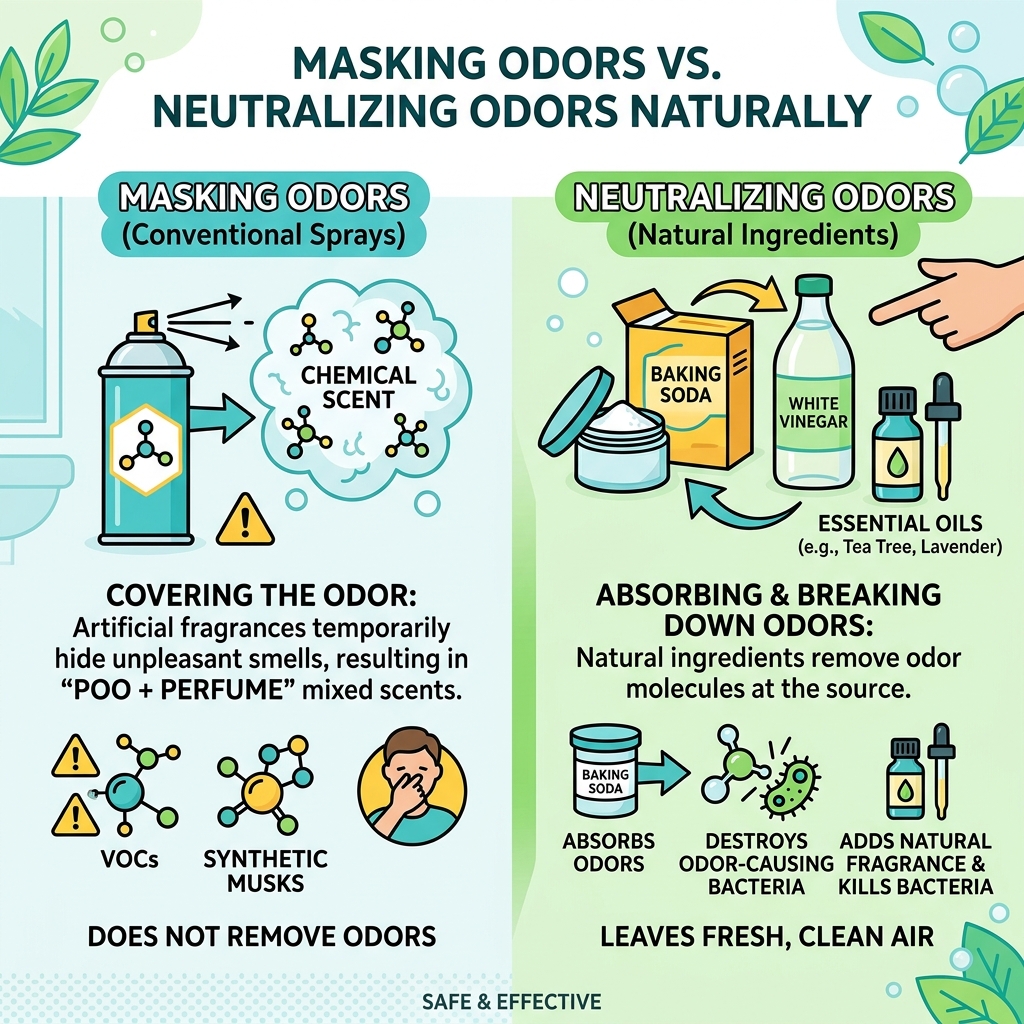
The Toxic Truth: Why Conventional Fresheners Fail
We’ve all been there: someone uses the bathroom, and the immediate reaction is to reach for a brightly colored aerosol can. We spray a literal cloud of “Summer Linen” into the air, hold our breath, and hope for the best. But have you ever noticed that ten minutes later, the room just smells like “Summer Linen” mixed with… well, the very thing you were trying to hide?
The reality is that conventional air fresheners are often a cocktail of volatile organic compounds (VOCs) and synthetic musks. When we use these products, we aren’t cleaning the air; we are polluting it. A survey of about 3,000 chemicals used in artificial fragrances found a staggering 884 toxic substances. These aren’t just “irritants”—many are linked to serious health concerns.
If you are looking to Reduce Chemicals in Home Cleaning, the bathroom is the best place to start. Because these rooms are typically small and poorly ventilated, the concentration of these chemicals becomes much higher than in an open living room.
Health and Environmental Risks
It’s not just about a temporary headache. Many of the ingredients in standard plug-ins and sprays are known endocrine disruptors. Specifically, 86% of plug-in air fresheners tested contain phthalates, which are chemicals known to interfere with hormone production and have been linked to reproductive issues.
For those of us with sensitive lungs or asthma, these sprays act as immediate triggers. The formaldehyde found in some aerosol formulations is a known carcinogen, and the VOCs can react with ozone in the air to create even more hazardous secondary pollutants. Beyond our own health, these chemicals eventually wash down the drain or settle on surfaces, contributing to water contamination and harming the planet. Transitioning to a natural bathroom odor remover isn’t just a “crunchy” lifestyle choice; it’s a fundamental step toward Non-Toxic Cleaning Tips for Bathroom safety.
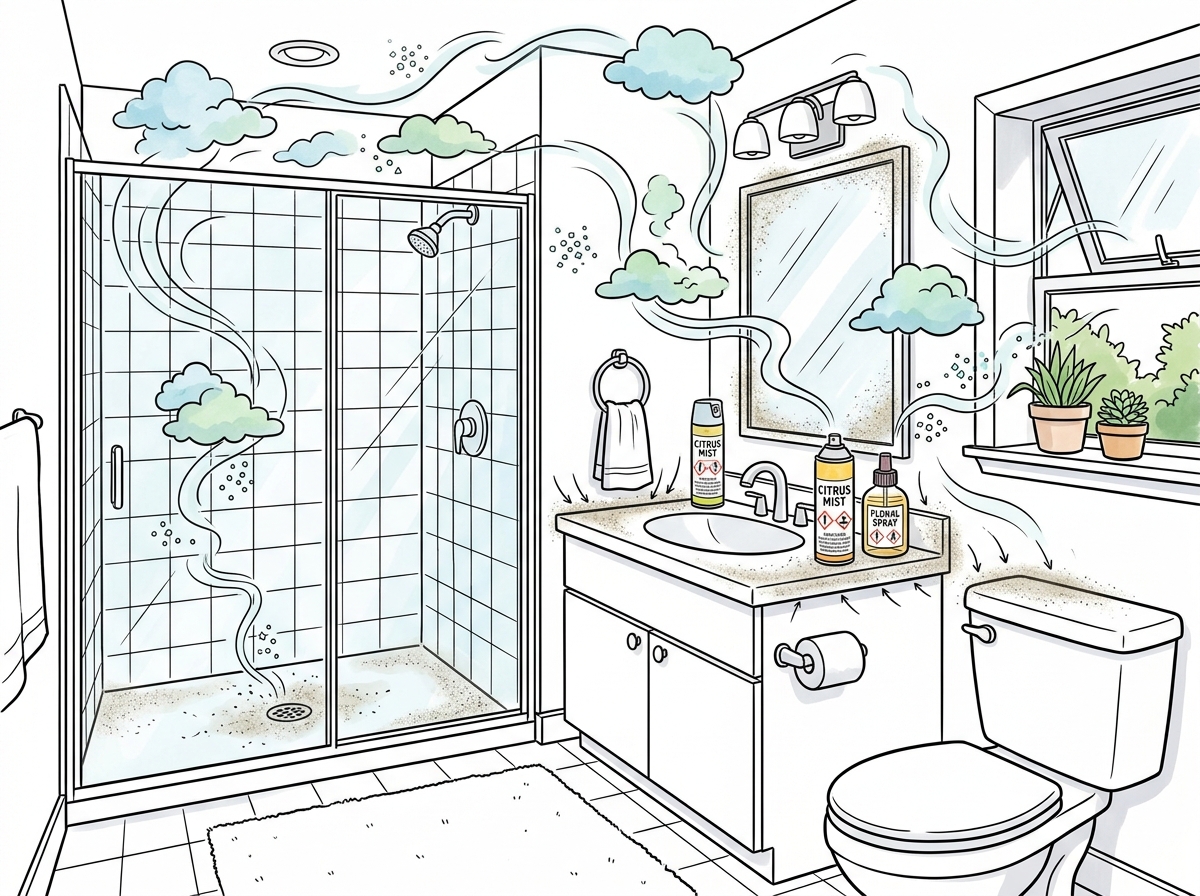
The Problem with Masking Agents
The biggest flaw in the “masking” strategy is that it ignores the science of smell. Odors are caused by molecules—often from bacteria, mold, or human waste. Conventional sprays use heavy synthetic perfumes to overwhelm your olfactory receptors. They essentially “blind” your nose to the bad smell by hitting it with a stronger, artificial one.
This leads to sensory irritation. Your body knows something is wrong, which is why many people experience sneezing or watery eyes after a heavy dose of floral spray. A true natural bathroom odor remover works differently: it seeks out the odor molecule and breaks it down or absorbs it entirely.
7 Brilliant Ways to Use a Natural Bathroom Odor Remover
Now that we know why the “blue-can-special” isn’t doing us any favors, let’s look at the alternatives. These seven methods are affordable, easy to implement, and—most importantly—they actually work.
1. The Vodka Neutralizing Mist
It sounds like the start of a party, but unflavored vodka is one of the most effective, scent-free air fresheners in existence. Alcohol is a natural solvent and disinfectant. When misted into the air, it attaches to odor molecules and neutralizes them as it evaporates.
How to make it:
- Mix 1 part unflavored, high-proof vodka with 3 parts distilled water in a fine-mist spray bottle.
- Optional: Add 5-10 drops of a clean essential oil like lemon or peppermint.
- Shake well and spray upward toward the ceiling.
This is particularly effective for removing that “stale” air smell that accumulates in bathrooms without windows. Since it leaves no residue and has no lingering scent of its own (once the alcohol evaporates), it is the ultimate discreet solution.
2. Essential Oil Toilet Paper Hack
If you want a continuous, passive natural bathroom odor remover without having to remember to spray anything, this is your secret weapon. The cardboard tube at the center of your toilet paper roll is the perfect porous surface for diffusing scent.
How to do it:
- Take your favorite essential oil (citrus oils are fantastic for this).
- Place 3-5 drops of the oil directly onto the inside of the cardboard roll.
- Every time someone pulls the paper, the roll spins, agitating the oil and releasing a fresh burst of scent.
Citrus oils like orange, lemon, and grapefruit are naturally uplifting and clean. We’ve found that Unlocking the Power of Citrus in Homemade Cleaning Solutions provides a double benefit: it smells great and offers mild antibacterial properties to the surrounding air.
3. Activated Charcoal Pouches
If you prefer a “set it and forget it” approach, activated charcoal is the gold standard. Unlike regular charcoal, activated charcoal has been treated to have millions of tiny pores. These pores act like a vacuum, pulling odors and excess moisture out of the air and trapping them inside the carbon structure.
These pouches are completely scent-free, making them perfect for people who are sensitive to even natural fragrances. You can tuck them behind the toilet, under the sink, or even inside a decorative basket. They are incredibly effective at preventing the musty smell caused by damp towels and high humidity.
4. Probiotic Air Purification
This is where the science of cleaning gets really exciting. Probiotic air removers use “good” bacteria to eat the “bad” bacteria that cause smells. Instead of just absorbing a smell, you are introducing a microscopic cleaning crew.
Some of the most advanced natural bathroom odor remover products on the market now use these non-GMO probiotics. Once sprayed, these beneficial microbes can continue to clean and neutralize odors on surfaces for up to 5 days. It’s a proactive way to manage the bathroom environment, especially in high-traffic households where odors tend to return quickly.
5. Baking Soda Deodorizing Bowls
We’ve all put a box of baking soda in the fridge, but for some reason, we forget it works just as well in the bathroom. Baking soda (sodium bicarbonate) is amphoteric, meaning it can react with both strong acid and strong base molecules. Since most foul odors fall into one of those categories, baking soda literally chemically neutralizes them.
To make it look a bit more “spa-like,” we recommend placing baking soda in a small decorative glass bowl. You can find more ideas on this in our guide to Unveiling the Power of Baking Soda: DIY Cleaning Solutions.
Pro Tip: Replace the baking soda every 30 days. To give it an extra boost, stir in a few drops of lavender or tea tree oil once a week to keep the scent fresh while the soda does the heavy lifting of pH neutralization.
6. White Vinegar Steam Clean
Vinegar is the Swiss Army knife of natural cleaning. The acetic acid in white vinegar is powerful enough to kill mold, mildew, and bacteria—the primary culprits of bathroom “funk.”
One of our favorite tricks is the “Vinegar Steam.” If your bathroom smells generally “off,” fill a bowl with white vinegar and leave it on the counter overnight. By morning, the vinegar will have pulled much of the odor out of the air. For a more direct approach, use a vinegar-water solution to wipe down the walls and the base of the toilet. The Magic of Vinegar in Homemade Cleaning Products is that it deodorizes as it dries; the sharp “pickle” smell disappears, taking the bathroom odors with it.
7. Hanging Eucalyptus Bundles
Finally, for the ultimate aesthetic and aromatic experience, try hanging fresh eucalyptus from your shower head. It’s not just for Instagram; it’s a functional natural bathroom odor remover.
When you take a hot shower, the steam releases the essential oils (eucalyptol) from the leaves. Eucalyptus is naturally antifungal and antibacterial. It helps clear the sinuses and leaves the entire room smelling like a high-end spa. It’s a beautiful way to maintain freshness while adding a touch of greenery to your space.
Science of Scent: How Natural Solutions Neutralize Odors
To understand why these methods work, we have to look at the chemistry. A “masking” agent is like putting a blanket over a pile of trash—the trash is still there, you just can’t see it. A “neutralizer” is like taking the trash out of the house entirely.
Plant oils and natural minerals like baking soda work through adsorption (trapping molecules on a surface) or chemical reaction (changing the structure of the odor molecule so it no longer triggers our scent receptors).
| Feature | Conventional Sprays | Natural Odor Removers |
|---|---|---|
| Action | Masks odors with perfume | Neutralizes molecules at the source |
| Ingredients | Phthalates, VOCs, Formaldehyde | Essential oils, minerals, probiotics |
| Health Impact | Can trigger asthma/allergies | Generally safe for respiratory health |
| Duration | Short-lived (minutes) | Long-lasting (hours to days) |
| Environmental | Can be toxic to aquatic life | Biodegradable and eco-friendly |
Choosing a Commercial Natural Bathroom Odor Remover
If you aren’t a DIY person, don’t worry. There are plenty of high-quality commercial options available that adhere to these natural principles. When shopping, look for products that are EPA Safer Choice certified. This ensures the ingredients have been vetted for human and environmental safety.
Look for plant-derived surfactants and avoid anything that simply lists “fragrance” or “parfum” on the label. Brands that use glass packaging are also a plus, as they reduce plastic waste and prevent chemicals from the plastic from leaching into the product.
How Plant-Based Ingredients Work
- Tea Tree Oil: A powerhouse antifungal. It’s perfect for bathrooms because it attacks the source of mildew smells.
- Citric Acid: Found in lemons, it’s excellent at breaking down hard water stains and urine salts that can trap odors in the toilet bowl.
- Cedarwood Oil: Provides a warm, woody scent while offering natural antimicrobial properties.
Maintenance and Safety: Keeping Your Bathroom Fresh Naturally
Even the best natural bathroom odor remover will struggle if the bathroom isn’t maintained. Odor prevention is a game of consistency.
Daily and Weekly Prevention Practices
We recommend a simple “Dry and Vent” routine. Moisture is the enemy of a fresh bathroom.
- Ventilation: Always run the exhaust fan during and for 15 minutes after a shower. If you don’t have a fan, open a window.
- Towel Management: Never leave damp towels in a heap on the floor. Hang them immediately to prevent that sour, mildewy smell.
- Drain Maintenance: Once a week, pour a half-cup of baking soda followed by a half-cup of vinegar down the sink and tub drains. Flush with hot water to keep biofilm from building up. You can find more Natural and Effective Drain Cleaner Recipes on our site.
- Surface Wiping: Use a microfiber cloth to wipe down wet surfaces. This prevents soap scum—a major odor trapper. For a full breakdown, check out our Zero-Waste Bathroom Cleaning Routine.
Is a Natural Bathroom Odor Remover Safe for Septic Systems?
One of the biggest advantages of going natural is the protection of your home’s plumbing. Harsh bleach and chemical cleaners can kill the beneficial bacteria in a septic tank, leading to expensive backups and failures.
Natural solutions like vinegar, baking soda, and plant-based cleaners are septic-safe and greywater-safe. They break down easily in the environment and won’t corrode your pipes. This makes them the ideal choice for Safe Cleaning for Pets and Kids, who are much more susceptible to the residues left behind by traditional cleaners.
Frequently Asked Questions about Natural Bathroom Odor Removers
What are the primary causes of unpleasant bathroom odors?
Most bathroom odors stem from four sources: bacteria (from waste), mold/mildew (from moisture), plumbing gases (from dry P-traps or clogged vents), and stale air (poor ventilation). Identifying which one is your main culprit helps you choose the right natural bathroom odor remover.
How do natural odor eliminators differ from traditional sprays?
Traditional sprays are designed to overwhelm your nose with scent. Natural eliminators are designed to interact with the odor molecules themselves—either by absorbing them (charcoal/baking soda), breaking them down (vinegar/probiotics), or neutralizing them through chemical bonding (essential oils).
Are essential oils safe to use around pets in small bathrooms?
While essential oils are natural, they are very concentrated. Some oils, like tea tree and peppermint, can be toxic to cats and dogs if ingested or if the concentration in a small room is too high. Always ensure the room is well-ventilated and keep the oils out of reach of your furry friends.
Conclusion
Creating a fresh, inviting bathroom doesn’t require a chemistry degree or a cabinet full of toxic aerosols. By switching to a natural bathroom odor remover, you are choosing a path that is better for your lungs, your family, and the planet. Whether it’s the simple power of a baking soda bowl or the high-tech cleaning of a probiotic spray, nature has everything we need to keep our homes smelling like a sanctuary.
At MoneyFinPro, we believe that a sustainable lifestyle starts with the small choices we make every day in our own homes. For more tips on maintaining a healthy, chemical-free environment, explore our More info about room cleaning services and join us in making the world a little cleaner, one room at a time.
